
Beat the Island Heat: Why Your Car’s Cooling System is the Unsung Hero of Every Commute (And No, It’s Not Just the A/C!)
Living in Waipahu, we all know the drill. You hop into your car after it’s been sitting in the sun all afternoon, the interior is pushing 120 degrees, and the first thing you do is crank that air conditioning to the max. We depend on that blast of cold air to make our daily commutes bearable, but there is another system working even harder behind the scenes to keep you from being stranded on the side of the H-1.
While the A/C system keeps you cool, your car’s cooling system keeps the engine alive. It’s easy to confuse the two, but they serve very different purposes. Think of the A/C as a luxury for your comfort and the cooling system as a vital health requirement for your vehicle’s survival. In the intense tropical climate we experience throughout Hawaii, your engine is constantly fighting an uphill battle against heat.
At Capitol Auto Service, we see the results of neglected cooling systems every day. What could have been a simple maintenance check often turns into a major car repair in Waipahu because the “unsung hero” under the hood finally gave up. Understanding how this system works: and why it’s so critical in our specific environment: is the best way to protect your investment and ensure your car stays reliable for years to come.
The Great Misconception: A/C vs. Engine Cooling
It’s a common mistake: a driver notices their car is running a bit hot on the gauge, so they turn the A/C up higher thinking it will help “cool the car down.” In reality, this is the worst thing you can do.
The air conditioning system is designed solely to remove heat and humidity from the cabin. To do this, it uses a compressor that is powered by the engine. When you turn on the A/C, you are actually putting more load on the engine, which generates even more internal heat.
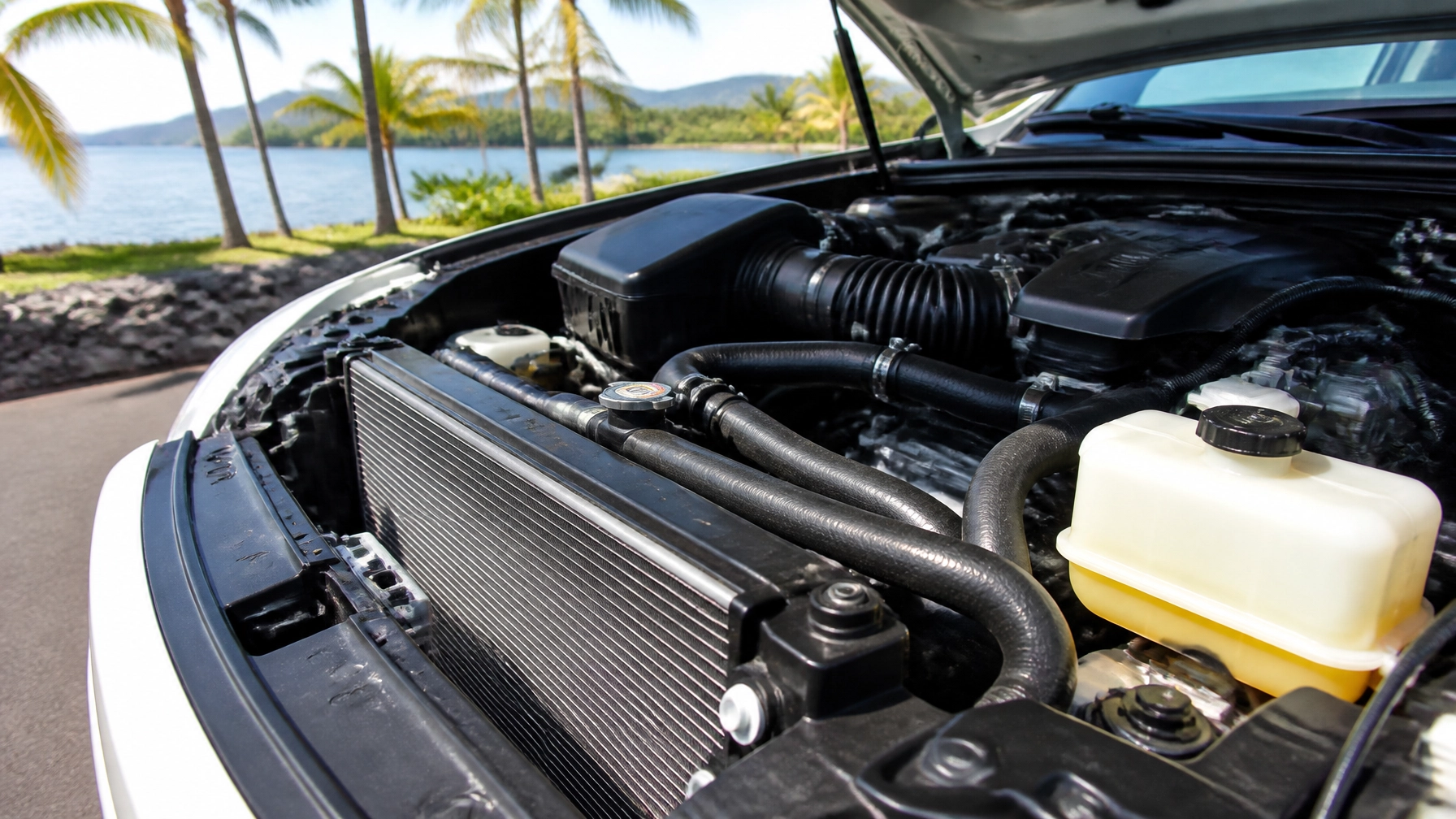
Your engine’s cooling system, on the other hand, is a closed loop of liquid coolant (antifreeze and water) that circulates through the engine block. It picks up the massive amount of heat generated by internal combustion and carries it to the radiator, where the rushing air from your drive (or a powerful fan) cools the liquid back down before it heads back into the engine.
If your engine’s cooling system isn’t 100% healthy, using the A/C can be the “final straw” that leads to overheating. That’s why many modern vehicles are programmed to automatically shut off the A/C if the engine temperature climbs too high. It’s the car’s way of saying, “I can’t handle the extra work right now!”
Why Island Driving is “Hard Mode” for Your Engine
Driving in Hawaii presents a unique set of challenges that you won’t find in the mainland’s cooler or drier states. For drivers near Waipahu, several factors contribute to a higher risk of cooling system failure.
1. High Ambient Temperatures
In many parts of the world, cars get a “break” during the winter. Here, the temperature stays consistently warm year-round. Your radiator relies on the temperature difference between the hot coolant inside and the outside air. When the outside air is already hot, the radiator has to work much harder to shed that heat. There is no “off-season” for your cooling system in the islands.
2. Stop-and-Go Traffic
The H-1 and local roads around Waipahu are notorious for heavy traffic. When your car is moving at highway speeds, a large volume of air naturally flows through the radiator. When you’re idling in traffic near the Farrington Highway, that airflow disappears. Your car has to rely entirely on its electric cooling fans. If those fans are weak or the radiator is partially clogged, the temperature will spike quickly during your afternoon crawl home.
3. Humidity and Salt Air
The moisture and salt in our air are great for the soul but terrible for metal. Over time, salt air can lead to corrosion on the delicate fins of your radiator and the metal components of your water pump. Internal corrosion is also a risk if your coolant is old and its protective additives have broken down. This is why having a trusted mechanic in Waipahu check your fluid quality is so important.
Signs Your Cooling System is Calling for Help
Your car usually tries to tell you there’s a problem before it leaves you smoking on the shoulder. Being proactive can save you thousands of dollars in engine repairs.
- The Rising Needle: Keep an eye on your temperature gauge. If it’s sitting higher than its usual halfway point, something is wrong. Don’t wait for it to hit the red zone.
- The “Sweet” Smell: Coolant has a very distinct, sweet, almost candy-like smell. If you smell this after parking or while sitting at a light, you likely have a small leak.
- Visible Puddles: If you see bright green, orange, or pink fluid on your driveway, that’s a clear sign of a cooling system leak.
- The Ticking Sound: Sometimes, an overheating engine will make a metallic ticking or “pinging” sound because the oil is becoming too thin to lubricate the moving parts properly.
- Steam: This is the universal sign of “game over.” If you see white steam (not smoke) coming from under the hood, pull over immediately and turn off the engine.

Framing Maintenance as an Investment, Not a Chore
We often talk to customers who view scheduled maintenance as an annoying expense. However, when it comes to your cooling system, maintenance is the best insurance policy you can buy.
A standard coolant flush is relatively inexpensive. In contrast, if your engine overheats to the point of failure, you could be looking at a blown head gasket, a warped cylinder head, or even a completely seized engine. These repairs are massive undertakings that can keep your car in the shop for weeks.
When you bring your vehicle to an auto repair shop in Waipahu, we don’t just look at the fluid level. We inspect the “health” of the entire system:
- Hose Integrity: Rubber hoses eventually become brittle or soft. A burst hose is one of the most common causes of sudden overheating.
- Thermostat Function: This small valve controls the flow of coolant. If it gets stuck closed, your engine will overheat in minutes.
- Water Pump Performance: The “heart” of the system needs to be pumping efficiently to keep the fluid moving.
- Radiator Condition: We check for external debris (like leaves or dirt) and internal scale buildup that prevents heat transfer.
What to Do if the Gauge Starts Climbing
If you’re driving throughout Waipahu and notice your temperature gauge creeping toward the red, don’t panic, but act quickly.
First, turn off the A/C. This immediately reduces the load on your engine. Second, it sounds counterintuitive, but turn your heater on to the highest setting. The heater core is essentially a small radiator; turning it on helps pull some of the excess heat away from the engine and into the cabin. It’ll be uncomfortable for you, but it might save your engine.
Finally, find a safe place to pull over and shut the engine off. Never attempt to open the radiator cap while the engine is hot. The system is under intense pressure, and opening it can cause a “geyser” of boiling coolant that will cause severe burns. Wait at least 30 to 60 minutes for the system to cool down completely before checking levels or adding water.
Trust the Professionals for Your Cooling System Needs
Your car’s cooling system is a complex network that requires specialized knowledge and tools to diagnose correctly. At Capitol Auto Service, we treat every cooling system inspection as a critical health checkup. Whether you’re noticing a small leak or you just haven’t had your coolant changed in a few years, our ASE-certified technicians are here to help.
Don’t wait until you’re stuck on the side of the road in the midday sun. Regular maintenance is the key to worry-free driving around Waipahu. We pride ourselves on honest, expert service that keeps our community moving safely.
If it’s been a while since your last cooling system check, or if your car just isn’t handling the heat like it used to, give us a call or stop by. Let’s make sure your “unsung hero” is ready for whatever the island weather throws its way.
Contact Capitol Auto Service today to schedule your cooling system inspection and stay cool on the road!
Related Posts

5 Steps to Prep Your Car for Hawaii’s Rainy Season (Easy Guide for Waipahu Drivers)
Hawaii’s rainy season runs roughly from October through April, making October a smart time to give your vehicle a seasonal health checkup. A few minutes spent checking your tires, visibility, battery, and drainage can help you avoid surprises when heavy…


Brake Pads vs. Brake Rotors: Which One Does Your Waipahu Car Actually Need?
When your brakes start squeaking, grinding, or vibrating, the first question is often: Do I need brake pads, brake rotors, or both? That is a fair question. Brake pads and rotors work together, but they are different parts with different…

5 Signs Your Suspension Is Failing (And Why Waipahu’s Potholes Make It Worse)
Your vehicle’s suspension does much more than make the ride comfortable. Springs, shocks, struts, control arms, bushings, ball joints, and related components help keep your tires connected to the road. That contact matters when you brake, turn, accelerate, or avoid…